
Resist Fundamentals
In EUV lithography, 92 eV photons absorbed by thin-film resists cause the emission of primary and secondary electrons that travel distances up to tens of nanometers before losing kinetic energy through collisions. These collisions — not the photons themselves — trigger the chemical reactions responsible for patterning. Because electrons play the leading role in EUV resist chemistry, understanding their generation, transport, and energy distribution is critical for designing next-generation resist materials.
CXRO operates a suite of complementary spectroscopic techniques to probe these fundamental processes in model and production-relevant resist films. By combining photoemission spectroscopy (PES), total electron yield (TEY), electron attenuation length (EAL) measurements, and Fourier-transform infrared spectroscopy (FTIR), we characterize how specific chemical groups impact EUV absorption, electron emission, electron blur, and exposure-induced chemistry.
We continue to develop new resist characterization approaches to understand EUV, Beyond EUV (BEUV, using wavelength below 13.5 nm), and electron-induced chemistry during the full exposure – post exposure bake – development pathway.
Measurement Techniques
Photoemission Spectroscopy (PES)
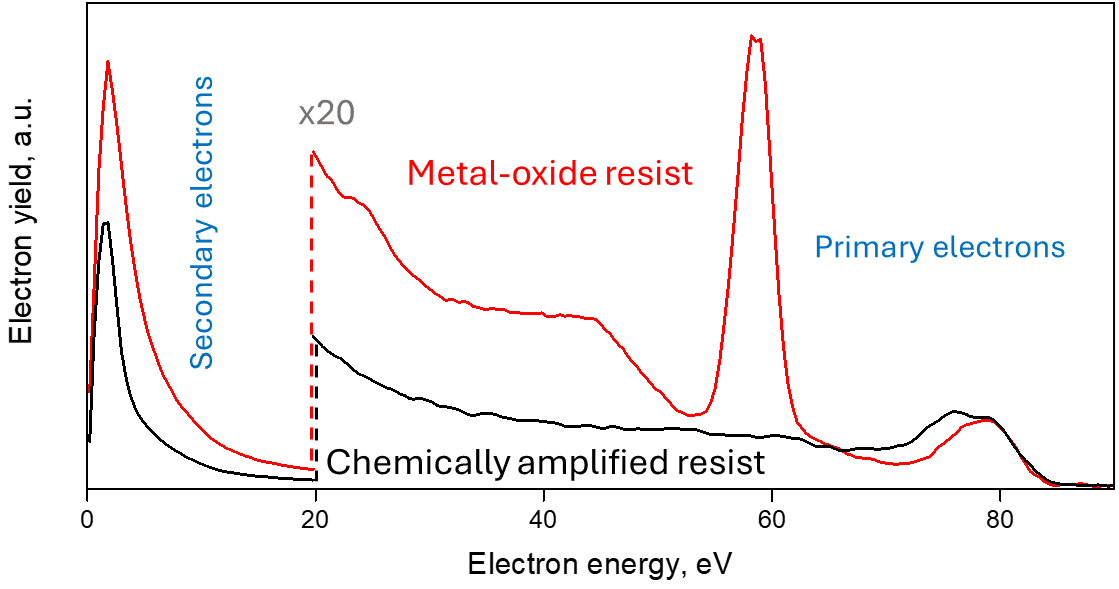
PES measures the kinetic energies and abundance of electrons emitted from resist materials upon EUV illumination. By resolving the full electron energy distribution, PES reveals how different chemical substituents influence the spectrum of primary photoelectrons and secondary electrons that drive resist reactions. Measurements are performed at 92 eV photon energy to match EUV lithography conditions.
Total Electron Yield (TEY)
TEY quantifies the total number of electrons escaping from a sample under EUV irradiation, providing a direct measure of how efficiently absorbed photons convert into free electrons. The measurement captures both primary photoelectrons and secondary electrons, making TEY a sensitive indicator of how changes in resist composition affect overall electron generation — a key parameter governing resist sensitivity.
Electron Attenuation Length (EAL)
EAL is the thickness of material required to reduce the number of emitted electrons to 1/e of their initial value. It directly determines the “electron blur” — the distance over which secondary electrons can travel and initiate chemistry beyond the intended exposure region. EAL is measured by monitoring electron drain current as a function of overlayer thickness, typically ranging from a few nanometers to tens of nanometers depending on material composition.
Fourier-Transform Infrared Spectroscopy (FTIR)
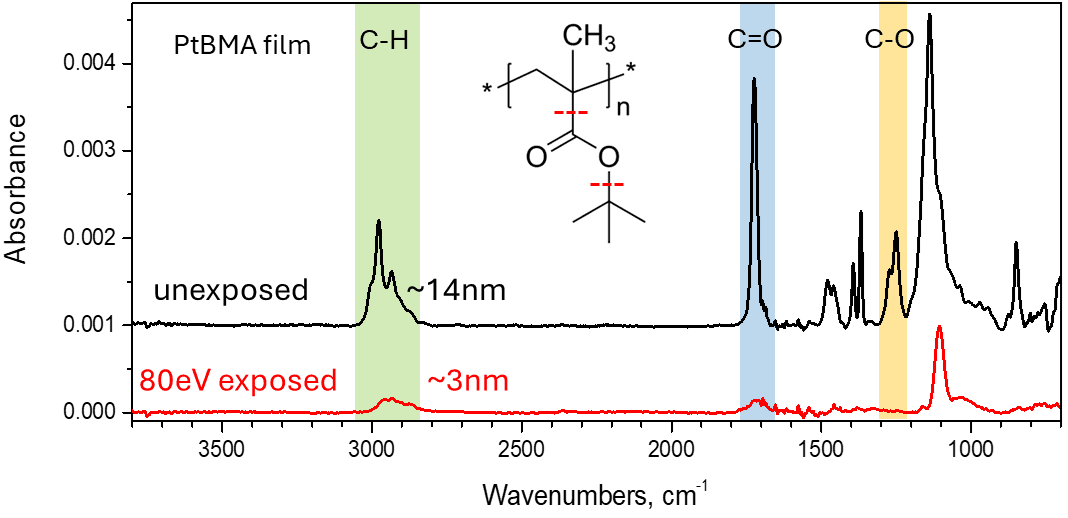
FTIR identifies functional groups and molecular vibrations in resist films by measuring their infrared absorption spectra at 6 cm−1 resolution. By comparing spectra of unexposed and exposed samples, FTIR reveals which chemical bonds are broken or formed during EUV, BEUV, or e-beam exposure, tracking photodissociation pathways, deprotection reactions, and crosslinking. This chemical fingerprinting complements the electron-emission data from PES and TEY.
Resonant Soft X-Ray Scattering/Reflectivity (RSoXS/R)
We develop critical-dimension resonant soft X-ray scattering and reflectivity (RSoXS/R) metrology to probe the chemical profiles of latent images stored in resist after exposure and post-exposure bake, which is crucial for understanding the resolution limits and stochastic effects in EUV lithography processes.

Electron-induced Chemistry
Electron-induced processes are studied using tunable electron-beam irradiation (with electron energies from 20 eV to 80 eV, or higher), with chemical changes characterized by outgassing measurements and ex situ FTIR.
High-throughput Dose-dependent Characterization
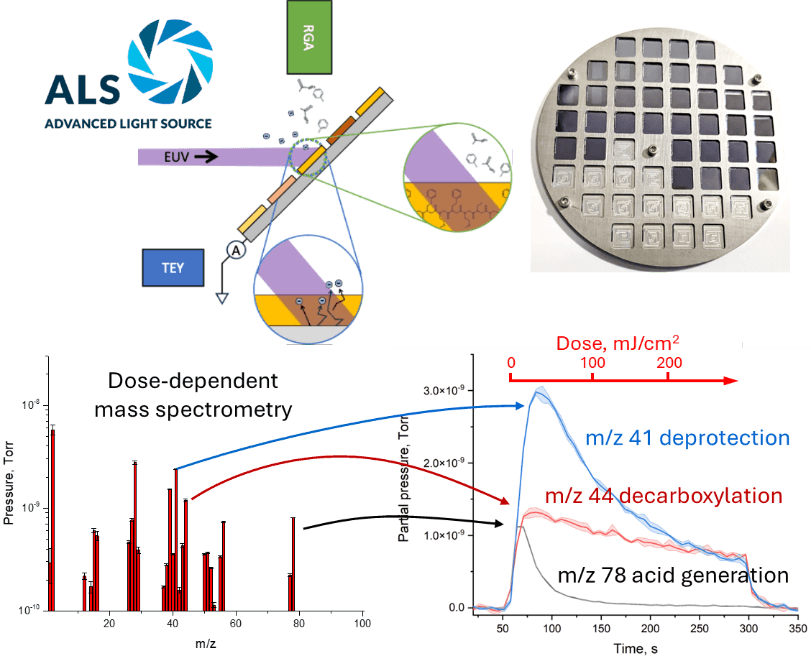
A high-throughput approach combining in situ mass spectrometry and TEY during EUV/BEUV exposure provides insight into exposure-induced chemical processes and outgassing. Post-exposure chemistry is further examined by ex-situ FTIR analysis of exposed regions before and after post-exposure bake.
Resist Sensitivity
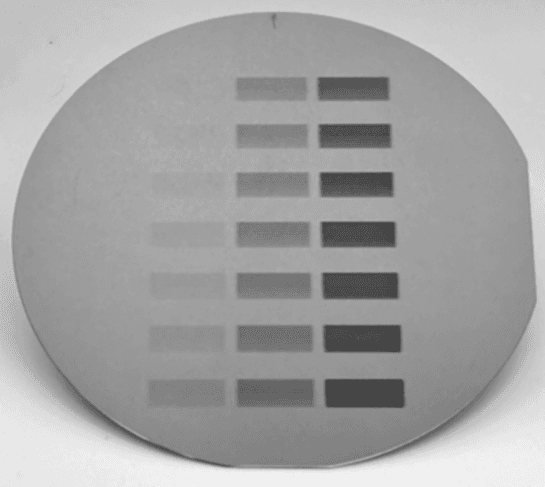
Resist sensitivity is evaluated through dose calibrations at multiple wavelengths, including 13.5 nm and 6.7 nm.
Resist Photon Absorption Efficiencies
Reflectometry at beamline 6.3.2 is used to determine EUV and Beyond EUV (BEUV, using wavelength below 13.5 nm) photon absorption efficiencies.
Why It Matters
Resist Sensitivity
TEY, PES, and dose calibration measurements reveal how efficiently a resist converts EUV photons into the electrons that initiate patterning chemistry, guiding the design of higher-sensitivity formulations.
Resolution & Blur
EAL measurements quantify how far secondary electrons travel before losing energy, directly informing achievable resolution limits and line-edge roughness in EUV patterning.
Exposure Chemistry
FTIR spectroscopy and outgassing tracks chemical changes during exposure, revealing fragmentation pathways in chemically amplified and metal-oxide resists.
Instrument Specifications
| Photon Source | Advanced Light Source (ALS) synchrotron: 92 eV (13.5 nm) EUV or 6.7 nm BEUV |
| PES Detector | Electron energy analyzer resolving photoelectron kinetic energies from 0 to 200 eV |
| TEY Measurement | Drain-current detection of total emitted electrons under EUV/BEUV illumination |
| EAL Method | Variable overlayer thickness with electron drain-current attenuation; typical EAL film thickness range 1–30 nm |
| FTIR Resolution | 6 cm−1; transmission geometry on thin-film (10-30 nm) samples |
| Sample Types | Spin-cast thin films on silicon substrates; model compounds and production resists |
| Environment | High vacuum for PES/TEY; ambient or nitrogen-purged for FTIR |
Applications
Chemically Amplified Resist (CAR) Characterization
PES, FTIR, and outgassing reveal how EUV-generated electrons trigger photoacid generation and deprotection reactions in CARs, connecting electron energy distributions to the efficiency of the chemical amplification cascade.
Metal-Oxide Resist Development
High-absorption metal-oxide resists emit more electrons per absorbed photon. TEY and EAL measurements help quantify this advantage and assess its impact on resolution and stochastic performance.
Light-Harvesting Substituent Design
By studying model compounds with targeted chemical groups, PES and TEY data guide the selection of substituents that maximize EUV absorption cross-section while controlling electron yield and blur.
Stochastic Defect Mitigation
Correlating electron emission statistics with patterning outcomes on the MET5 supports efforts to reduce stochastic defects by optimizing resist electron-generation efficiency.
Related Research
Resist fundamentals research directly supports EUV Lithography Science and Microelectronics programs. Patterning experiments are performed on the MET5.

